



-
 Home > NEWS > Industry News
 Back to Overview
The Relationship Between Papermaking Forming Fabrics and Paper Two-Sidedness
 2022-08-11
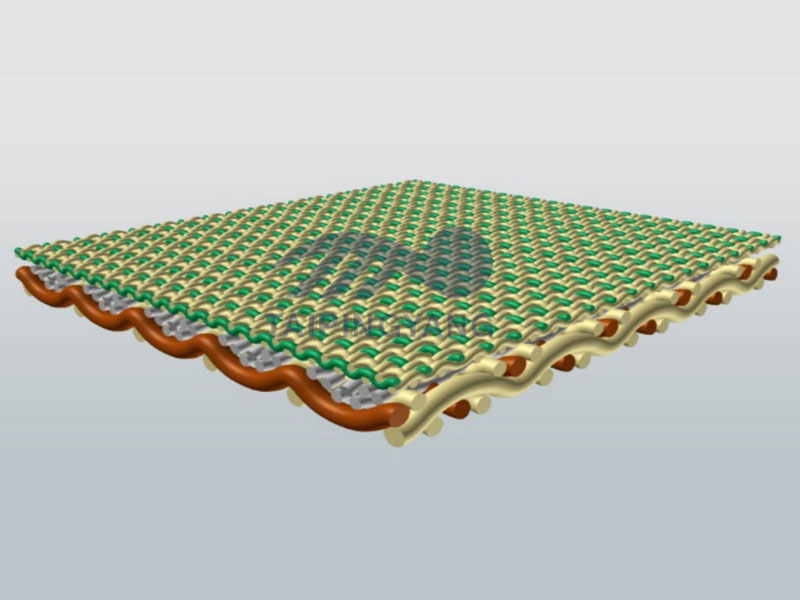
During the papermaking process, one side of the paper comes into contact with the forming fabric, resulting in a mesh pattern on that side, while the other side remains smooth. This creates differences in properties between the two sides of the paper, a phenomenon known as two-sidedness.
The forming fabric primarily orients fibers in the machine direction, leading to a higher proportion of longitudinally aligned fibers on the wire side compared to the top side. As these fibers swell upon wetting, stress differences arise between the two sides of the paper. Since fiber swelling and shrinkage are more pronounced in diameter than in length, paper two-sidedness is inherently unavoidable.
Additionally, during paper formation, water moves from the top side toward the wire side, causing uneven distribution of fine fibers, fillers, and sizing agents between the two surfaces. The top side tends to accumulate more of these materials, while the wire side retains less. As a result, on conventional fourdrinier paper machines, the top side generally exhibits higher smoothness and sizing efficiency than the wire side.
Two-sidedness can be mitigated by measures such as replacing table rolls with gentler dewatering foils, using smoother forming fabrics, and incorporating retention aids.
However, the most fundamental solution lies in adopting advanced forming technologies, such as twin-wire or hybrid formers, to produce paper with more uniform properties.
PREVIOUS:
Anhui Taipingyang Special Fabric Co., Ltd
In Chengguan Town Industrial Park, Taihe County, Anhui Province